Please Choose Your Language
Views: 0 Author: Site Editor Publish Time: 2026-09-14 Origin: Site
Navigating the commercial electrical equipment market often feels incredibly frustrating. Opaque pricing structures heavily plague high-capacity units like 1000kVA transformers. Procurement teams frequently struggle to secure clear, reliable upfront numbers. These hidden variables make budgeting a major headache for infrastructure projects. Price quotes vary wildly across different manufacturers and global regions. Fluctuating raw material costs and persistent supply chain bottlenecks constantly shift baseline figures. Furthermore, varying compliance and safety standards dramatically alter your final invoice.
This guide breaks down the exact variables dictating a 1000kVA transformer’s price. It provides procurement managers and engineers with a completely transparent evaluation framework. You will learn to assess complex bids confidently and identify hidden fees. Our insights help you project long-term financial impacts accurately while avoiding common procurement traps. We explore material choices, efficiency compliance impacts, and logistics hurdles in granular detail.
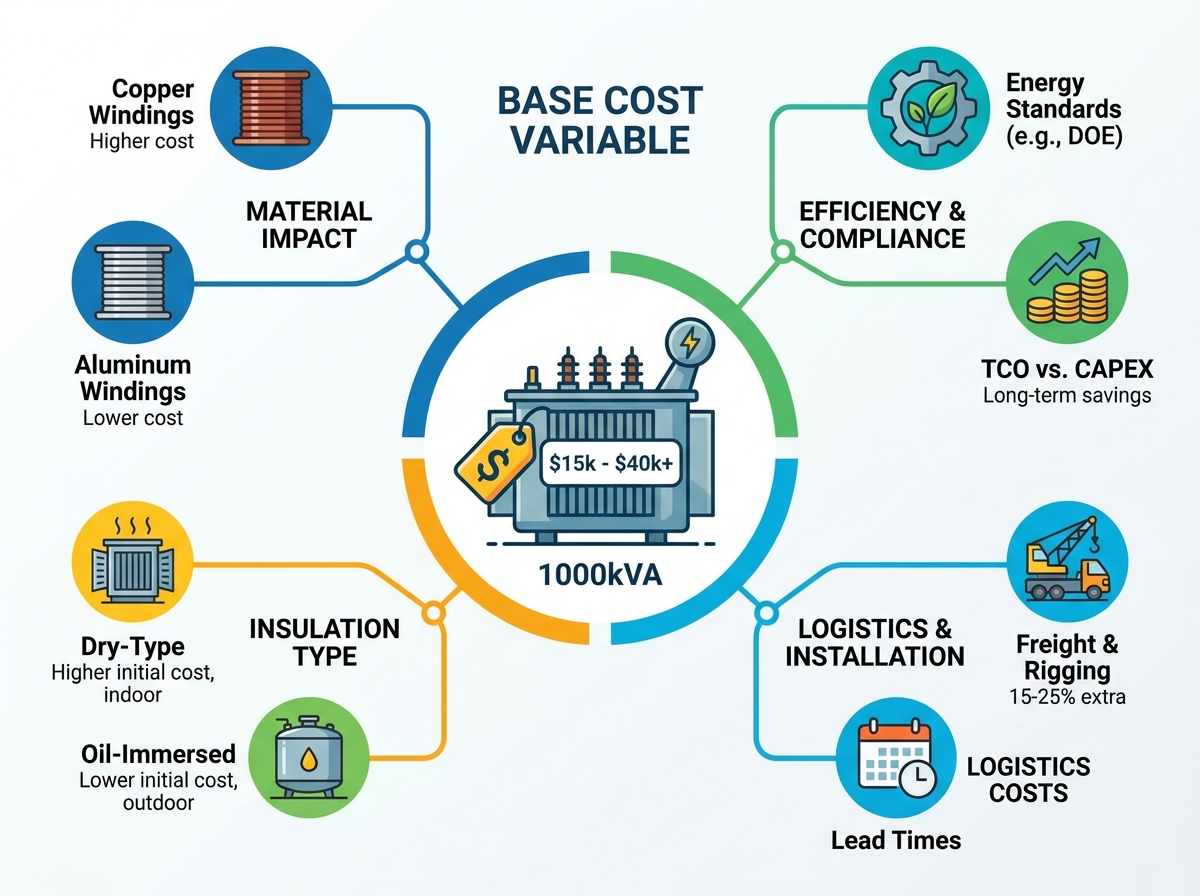
Base Pricing: A new 1000kVA transformer typically ranges from $15,000 to $40,000+, heavily dependent on core materials and insulation type.
Material Impact: Copper windings cost significantly more upfront than aluminum but offer superior energy efficiency and a smaller footprint.
Insulation Differences: Dry-type transformers carry a higher initial price tag than oil-immersed models but are mandatory for certain indoor/commercial applications due to fire safety codes.
Hidden Costs: Freight, specialized rigging, and installation often add 15–25% to the total capital expenditure.
Understanding initial cost expectations requires a look at current market averages. A standard 1000kVA configuration typically runs between $15,000 and $40,000. However, this broad window exists because base pricing remains highly sensitive to global commodities. Volatility in copper and steel markets causes month-to-month price fluctuations. Manufacturers adjust their quotes based on real-time material indexes. You should always check the validity period of your quote. Bids are often only valid for 15 to 30 days due to these rapid shifts.
Industry professionals frequently rely on the "price per kVA" metric for quick evaluations. You calculate this by dividing the total unit cost by its kilovolt-ampere rating. A $25,000 unit yields a metric of $25 per kVA. This ratio helps you compare competing bids rapidly. It also scales differently depending on unit size. Smaller distribution transformers usually exhibit a higher price per kVA. For example, a 100kVA model might cost $40 per kVA. The 1000kVA unit benefits from distinct economies of scale. Manufacturers distribute fixed engineering and enclosure costs over a much larger capacity output.
Budget constraints often push buyers toward refurbished or reconditioned equipment. Analyzing the cost savings reveals an attractive short-term picture. Reconditioned units are routinely 30% to 40% cheaper than brand-new alternatives. You might secure a functioning 1000kVA unit for under $12,000. However, you must carefully weigh the associated risks against these initial savings.
Reduced Warranties: New units usually carry multi-year guarantees. Refurbished units often max out at a one-year limited warranty.
Older Efficiency Standards: A reconditioned unit likely reflects the manufacturing standards of its original build year. It may miss modern efficiency benchmarks entirely.
Potential Hidden Wear: Previous thermal stress degrades internal paper insulation over time. You cannot easily see this wear without invasive teardowns.
Best Practice: If you opt for refurbished equipment, demand comprehensive testing reports. Always request recent Megger and dissolved gas analysis (DGA) results before signing the purchase order.
The physical materials inside the enclosure drive the bulk of the manufacturing expense. Engineers must balance electrical performance with material costs. These engineering decisions directly shape your final purchase price.
Manufacturers construct transformer coils using either copper or aluminum. Copper commands a massive upfront cost premium. It trades much higher on global commodity exchanges than aluminum. However, copper offers unmatched electrical conductivity. This superior conductivity translates directly into lower I⊃2;R losses during operation. Copper also allows manufacturers to design a smaller, more compact unit. This smaller footprint proves invaluable in cramped urban environments.
Aluminum windings represent the budget-friendly alternative. They cost significantly less to produce. To achieve the same 1000kVA capacity, engineers must use thicker aluminum conductors. This requirement increases the overall physical size of the core and enclosure. While aluminum saves capital upfront, it generally runs slightly hotter. You must justify the ROI of premium copper materials through long-term operational savings.
Specification | Copper Windings | Aluminum Windings |
|---|---|---|
Upfront Cost | High Premium | Budget Friendly |
Energy Efficiency | Excellent (Lower I⊃2;R losses) | Standard (Higher baseline losses) |
Physical Footprint | Compact and dense | Larger and bulkier |
Operational Longevity | Superior resistance to thermal stress | Good, but expands more under heat |
Transformer cooling systems fall into two primary categories. The choice between oil-immersed and dry-type architectures drastically alters the price tag.
Oil-Immersed: These units feature a lower initial cost. Mineral oil provides exceptional heat dissipation and dielectric strength. They represent the industry standard for outdoor pad-mounted applications. The manufacturing process is straightforward, keeping assembly expenses low.
Dry-Type (Cast Resin/VPI): These models carry a substantially higher manufacturing cost. Engineers use Vacuum Pressure Impregnation (VPI) or cast resin techniques to seal the coils. They contain no flammable liquids. Strict indoor safety compliance often dictates their use. Local fire codes usually mandate dry-type units inside commercial high-rises or hospitals. They cost more upfront but require significantly less routine maintenance.
A 1000kVA rating serves as a highly standard size for three-phase commercial systems. Mass production keeps these three-phase units relatively affordable. However, specialized legacy setups occasionally require different approaches. Custom requests for banking large-scale Single Phase Transformers to achieve similar capacity carry entirely different pricing structures. Stringing three massive single-phase units together increases manufacturing complexity. It demands more total enclosure material, separate mounting hardware, and intricate wiring. This non-standard approach expands footprint requirements dramatically and escalates installation complexities.
Governments worldwide continually push for greener electrical grids. Compliance is no longer optional. Adhering to these regulatory frameworks directly impacts manufacturing costs and retail pricing.
Strict energy efficiency mandates shape modern equipment designs. In the United States, the Department of Energy (DOE 2016) enforces rigorous baselines. Europe utilizes the stringent Tier 2 EcoDesign directive. Adherence to these mandates dictates core steel quality. Manufacturers must reduce no-load (core) losses significantly. They achieve this by upgrading from standard grain-oriented silicon steel to premium amorphous steel. Amorphous metal possesses a unique atomic structure. It minimizes magnetic hysteresis and eddy currents. However, amorphous steel is brittle and difficult to machine. This complexity drives up initial manufacturing costs noticeably.
Savvy procurement teams look past the initial invoice. You must evaluate the long-term value against your upfront capital expenditure. A framework for calculating long-term energy savings over a 25-30 year lifespan is essential.
Consider the daily operational reality of a 1000kVA unit. It runs 24 hours a day, 365 days a year. Even a 1% difference in efficiency yields massive energy consumption variations. A cheaper, non-compliant unit wastes significant power as heat. It literally burns through your operational budget. The math consistently shows a stark reality. The cheaper unit costs more in energy waste within the first five years alone. Paying a $5,000 premium for high-efficiency core steel often returns tens of thousands in utility savings over the equipment's lifespan.
Common Mistake: Purchasing agents sometimes isolate their capital budget from the facility’s utility budget. This siloed thinking leads to buying the cheapest unit available, unknowingly punishing the operations team with decades of inflated energy bills.
The price of heavy electrical equipment is not determined purely by materials. Global logistics and manufacturing backlogs play massive roles in the final quote.
Current supply chain constraints affect pricing heavily. If you have time, factory-direct custom builds remain the most economical route. You avoid middleman markups and warehousing fees. However, custom builds routinely take months to complete. When critical infrastructure fails, facilities cannot wait. In-stock or expedited units command significant price premiums. Distributors charge hefty markup fees for immediate availability. If you need a 1000kVA unit shipped tomorrow, expect to pay 20% to 40% above standard factory pricing.
Many buyers experience sticker shock when the freight bill arrives. You must break down the logistics of moving industrial equipment. A standard 1000kVA unit weighs between 5,000 to 8,000 lbs. You cannot simply drop this off with a standard delivery truck.
Specialized Transport: Moving 8,000 lbs requires heavy-duty flatbed transport. Freight companies charge premium per-mile rates for this weight class.
Rigging and Cranes: Offloading the unit necessitates heavy rigging equipment. Crane rentals run thousands of dollars per day. You also pay for specialized rigging crews.
Site Accessibility: Urban environments complicate deliveries. You might need street closure permits and police escorts. Rural deliveries might struggle with unpaved access roads. Site accessibility must be factored into the initial budget early on.
Receiving multiple bids often creates confusion rather than clarity. Quotes vary in detail, layout, and terminology. You need a structured approach to filter out deceptive pricing.
Never assume two quotes offer the exact same machine. You must verify critical specifications line by line.
Verify Winding Materials: Ensure both quotes specify either copper or aluminum. Do not compare an aluminum quote against a copper quote without adjusting expectations.
Check Impedance Percentage (%Z): Impedance affects voltage drop and short-circuit currents. Ensure the quoted %Z aligns with your facility's coordination study.
Review Temperature Rise Limits: Standard rises are 80°C, 115°C, or 150°C. Lower temperature rise designs require more materials and cost more, but they last longer.
Confirm NEMA Enclosure Ratings: An indoor NEMA 1 enclosure is vastly cheaper than a weatherproof NEMA 3R or severe-duty NEMA 4X stainless steel enclosure.
Quality assurance should never be an afterthought. Advise buyers to look for Factory Acceptance Testing (FAT) inclusion in the quote. FAT proves the unit meets specified parameters before it leaves the plant. You should also demand third-party certifications. Look for explicit UL, CSA, or CE marks depending on your region. Uncertified units present massive safety and insurance liabilities.
Treat the warranty length as a critical financial differentiator. A five-year comprehensive warranty offers immense value over a standard one-year term. When sourcing diverse equipment lineups, such as industrial three-phase units and specialized Single Phase Transformers, verify the warranty coverage applies equally to all catalog items. Post-sale support matters heavily. Ask if the manufacturer provides local field technicians. Troubleshooting a faulty 8,000 lb machine over the phone is practically impossible.
Procuring high-capacity electrical infrastructure demands careful financial analysis. The cheapest initial quote rarely translates to the lowest long-term cost. You must factor in energy efficiency, routine maintenance, and expected lifespan. Core materials, compliance standards, and logistics realities all drastically alter the final price tag.
Your next action is simple. Always encourage buyers to request detailed, itemized bids from manufacturers. Force suppliers to separate the base unit cost from freight charges, specialized accessories, and testing fees. This transparency ensures accurate comparison and empowers you to make a financially sound engineering decision.
A: A 1000kVA pad-mounted transformer typically weighs between 5,000 and 8,000 lbs (2,260 to 3,600 kg). Oil-filled units are generally heavier due to the volume of dielectric fluid. Dry-type units fall on the lighter end of this spectrum. Always confirm exact dimensions and weight with the manufacturer for accurate freight estimation.
A: Standard lead times for custom-engineered 1000kVA units range from 12 to 24 weeks. This timeline fluctuates based on raw material availability and factory backlogs. In-stock, standardized configurations might ship within days, but they command higher premium pricing due to immediate availability.
A: Copper offers superior electrical conductivity, lower energy losses, and a smaller physical footprint. It represents the best long-term investment. Aluminum is significantly cheaper upfront but requires a larger enclosure and runs slightly less efficiently. Your choice depends entirely on prioritizing immediate capital budgets versus long-term operational savings.
A: Indoor facilities generally require dry-type transformers. Local fire codes and commercial insurance policies strictly regulate flammable liquids indoors. Dry-type units eliminate the fire hazards associated with mineral oil. Oil-filled transformers are primarily reserved for outdoor pad-mounted applications or highly specialized fire-rated vaults.